
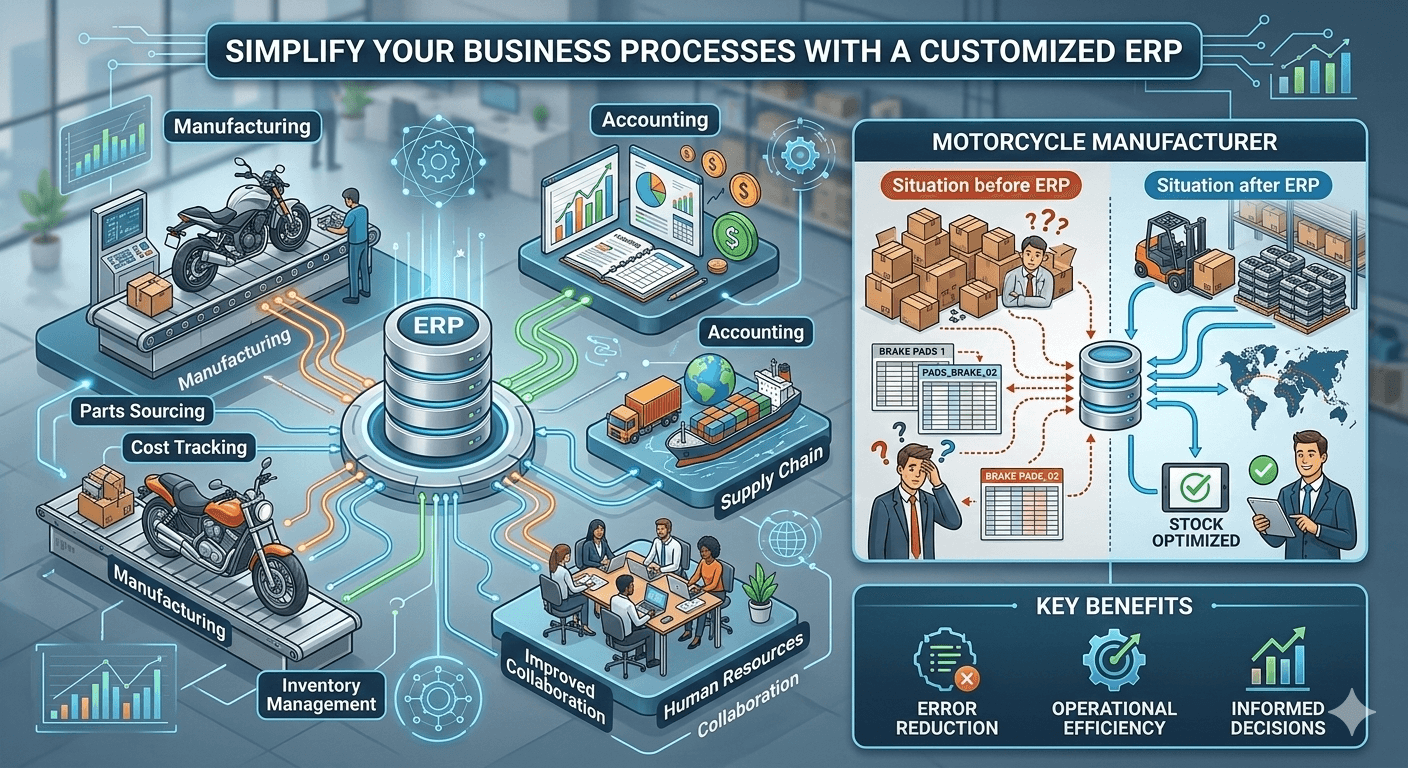
In the modern business world, efficiency and organisation are key elements of success. One of the tools that can transform the way a company operates is an ERP system (Enterprise Resource Planning). This software solution is designed to centralise and automate business processes, providing an integrated and real-time view of the company's activities. This article will explain how a customised ERP can simplify your processes and provide a concrete example of its use in the motorcycle manufacturing industry.
What does ERP mean?
ERP, or Enterprise Resource Planning, refers to a software system that helps companies manage and control business resources and processes. This system integrates various functions, such as accounting, inventory management, human resources, and supply chain management, into a single platform.
Why do you need an ERP?
Data centralization. All important company information is stored in one place, making data access easier and improving decision-making.
Process automation. An ERP can automate repetitive processes, reducing human errors and saving valuable time.
Improved collaboration. All departments can access the same information, enhancing communication and collaboration between teams.
How does an ERP system work?
An ERP functions by integrating different company functions into a single coherent system. It uses a common database to ensure that all departments have the same up-to-date information. The way an ERP works can vary depending on the specific needs of the company, but generally includes the following stages:
Data collection: Information is clearly entered into a centralised database.
Data processing: The system analyses and organises the data to provide detailed reports and analyses based on which major business decisions are made.
Information distribution: Data is distributed to all departments that need it to function efficiently.
Let's see what ERP implementation means for a motorcycle manufacturer!
Take the example of a motorcycle manufacturer that sources parts and components from multiple suppliers. This company can use an ERP to track the purchasing and inventory management processes.
Situation before ERP
Without an ERP system, this company might encounter difficulties in efficiently managing inventory and orders. Information might be stored in separate spreadsheets or different software systems, leading to confusion and errors. For example, an important component like "brake pads" might be named differently in various systems, complicating cost and inventory tracking.
Implementing an ERP
With an ERP, each part is uniformly identified by a set of attributes, such as part name, size, material, and cost. This data is centralised and accessible to all departments involved in the production process. The ERP system can automate supply orders when stocks are low and generate detailed reports on costs and supplier performance.
Benefits
Error reduction. Uniform naming and information eliminate confusion and errors in supply and production processes.
Operational efficiency. Process automation saves time and resources, allowing employees to focus on more important activities.
Informed decisions. Detailed and up-to-date reports help managers make better strategic decisions and improve supplier relationships.
Customised ERP optimises company operations
A customised ERP system can transform how a company operates, bringing significant benefits through data centralisation, process automation, and improved communication between departments. The motorcycle manufacturer's example illustrates how an ERP can simplify processes and contribute to a business's long-term success. In a world where competitiveness is continuously increasing, adopting an ERP can be the difference between success and stagnation.
If you want to find out what a customised ERP means for your business, contact Matteale and request a free consultation! Our experts can help you identify the best solutions for your company.